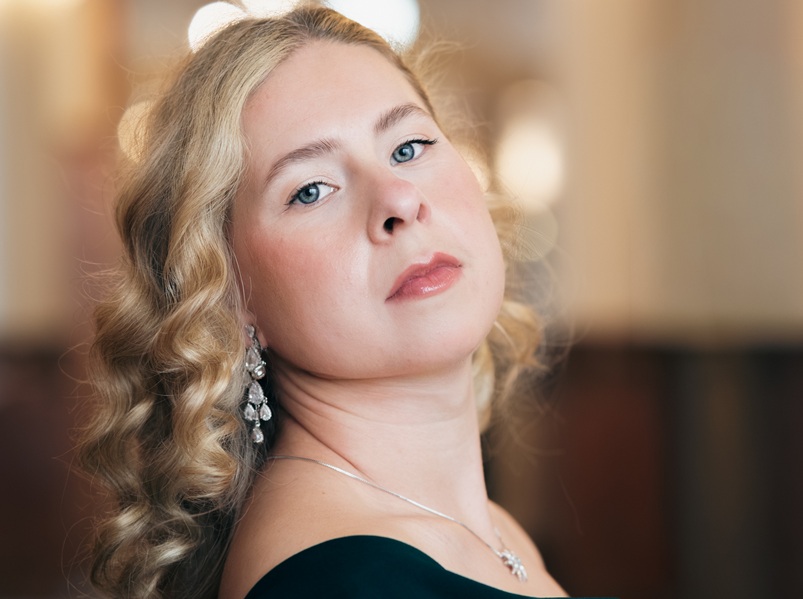
This time, PianoMe spoke with Katherine Barr about her journey as an opera singer, the roles she has performed and what it means to build an artistic career in today’s world. We also spoke about her work as a music teacher, the challenges and opportunities she encounters as a mezzo-soprano, and how performing and teaching influence one another. Katherine shared her thoughts on how the interpretation of opera roles can evolve over time, whether singers should primarily interpret a composer’s intentions or bring their own perspectives to a role, and how today’s world might influence the way we understand stories written centuries ago. She also told us more about her teaching activities and why she appreciates the idea behind PianoMe.
PianoMe (PM): Thank you so much for taking the time to join us for this interview. It’s a real pleasure to have you here, and we’re delighted to share your story, your experiences, and your perspective with the PianoMe community.
Katherine Barr (KB): Thank you! It is wonderful to be here today.
PM: Thank you! First, we would like to introduce you briefly to our readers, even though many of them may already know you. You are a Canadian mezzo-soprano, performer, and music educator. You studied at Western University and have performed a diverse range of operatic roles, including Madame de la Haltière in Cendrillon, Glascha in Káťa Kabanová, and the Mother and Witch in Hansel and Gretel. Alongside your performing career, you have been teaching music and voice for more than ten years. You continue to develop your performing career while pursuing your passion for teaching and music education. We’re delighted to learn more about your journey, your work, and your perspective on the world of opera.
KB: I’m happy to share my story and a little about my journey in music. Thank you for having me!
PM: Let’s start at the beginning. How did your musical journey begin, and what first drew you to singing?
KB: My musical journey really began when I was very young. Music was always around me because my whole family is musical. My father plays guitar, my sisters sing and play the violin, and I grew up singing and playing the piano. My parents recognized pretty early on that music was something I connected with, so they encouraged me to audition for the Hamilton Children’s Choir.
PM: Interesting! What do you remember most vividly about your early experiences, and how did they shape your relationship with music and the stage? Was there a particular teacher, mentor, or musical experience during those formative years that had a lasting influence on you?
KB: I remember how passionate my choir director, Zimfira Poloz, was about music. She influenced everyone around her with her positive energy and enthusiasm.
I was very fortunate to travel with the Hamilton Children’s Choir to Europe several times for choir festivals and competitions. I still remember the first time we won first prize, realizing how much of a team effort it was and how much hard work had gone into getting us there.
I also had the incredible opportunity to audition for the role of the Third Spirit in The Magic Flute with the Hamilton Opera Company. That was when I really fell in love with being on stage. I remember how excited I was on performance days, and I can still recall so many of the wonderful people I met through that production. It was definitely a core memory for me.
Katherine Barr: From musical training to the opera stage
PM: You studied at Western University in London, Ontario, earning both a Bachelor of Musical Arts and an Artistic Performance Diploma. What were the most formative aspects of your musical education?
KB: University was really the point when I began transitioning from choral singing into classical and operatic repertoire, so it required a completely different approach to technique. I had to learn a lot very quickly about how to use my voice as a solo instrument rather than as part of an ensemble.
PM: How did your understanding of yourself as a singer develop during your university years and through your professional training?
KB: As I continued into professional training, I became more aware that technique is not about creating one particular sound, but about understanding my own instrument and allowing it to work as freely and naturally as possible.
I think I have also learned that understanding yourself as a singer is an ongoing process. Your voice continues to develop, as do your interpretation, confidence, and sense of who you are as an artist. The more experience I gain, the more I understand the importance of staying curious, listening to my body and being willing to continue learning.
PM: Many people might assume that once a singer has completed their formal studies, the learning process is largely over. However, you continue to study with Jessica Cambio and are participating in the Cambio Masterclass program in Vienna. How important is continued training at this stage of your career? What do ongoing study and artistic development mean to you as a professional singer?
KB: I don’t think a singer ever really reaches a point where there is nothing left to learn. The voice continues to develop, repertoire becomes more demanding, and your understanding of yourself as an artist changes with experience.
Ongoing study gives me the opportunity to keep refining my technique, maintain healthy vocal habits, and work through new challenges with teachers and coaches I trust.
For me, artistic development also goes beyond technique. It includes interpretation, language, style, acting, confidence, and learning how to communicate with authenticity. Continued training keeps me curious, and as I continue to grow, I become more confident in who I am as an artist.
Opera in a changing world: between history and interpretation
PM: The mezzo-soprano repertoire encompasses a remarkable range of characters, from deeply dramatic and powerful roles to comic, youthful, maternal, mysterious or even villainous figures. What attracts you most about the world of mezzo-soprano roles?
KB: One of the things I love most about the mezzo-soprano repertoire is the variety. I have never been someone who enjoys doing the same thing over and over again, and that is true both in my life and in my work as a singer. As a mezzo-soprano, I can move from playing a teenage boy in a trouser role to a deeply dramatic woman, a comic character, a mother, or even a villain. That range keeps the work exciting and constantly challenges me in different ways. I always love a good challenge!
I also love that the repertoire itself can be so varied. I really enjoy singing coloratura and the agility, precision, and energy that it requires, but there is something about a strong dramatic role that always pulls me in.
For me, that combination of vocal variety and dramatic variety is what makes being a mezzo-soprano so exciting!
PM: Many opera characters were created centuries ago, often reflecting the values, social structures, and expectations of their time. Do you think the current situation in the world changes the way we look at opera and the stories it tells? Are there themes or characters that may be understood differently today than they were in the past?
KB: I definitely think the world we live in changes the way we understand opera.
As a mezzo-soprano, I find it especially interesting because the repertoire allows me to portray such a wide range of characters, including both male and female roles. Singing trouser roles as well as women with very different social positions has made me think more about gender, expectations, freedom, and who is allowed to have power within a story.
At the same time, I think one of the reasons opera continues to connect with people is that the emotions at the centre of these stories are still very human: love, jealousy, ambition, betrayal, grief, desire, and family.
PM: When performing a role, where do you see the balance between respecting the historical context of a work and bringing your own perspective to it? Should opera singers primarily be interpreters of a composer’s intentions, or do they also have a responsibility to reinterpret a character through the lens of their own time?
KB: I believe an opera singer should first try to understand and honour the composer’s intentions as fully as possible. The musical notation, phrasing, dynamics, and text are all there for a reason, and they often reveal a great deal about the character before we add anything of our own.
Once that foundation is in place, there is still plenty of room for personal interpretation. Two singers can perform the same role, follow the same score, and still create very different experiences for an audience because they bring their own understanding, instincts, and emotional perspective to the character. For me, the goal is to respect what is written while still finding something truthful and personal within it.
Teaching music: supporting the next generation
PM: Thank you for sharing your thoughts. Alongside your performing career, you have more than ten years of teaching experience and run your own private voice and piano studio, Barrofmusic. What first inspired you to become a teacher?
KB: I’m not sure there was one specific moment that inspired me to become a teacher. I just remember knowing from a very young age that I wanted to be both a singer and a teacher. By about Grade 3, that was already the path I imagined for myself.
I loved my elementary school teachers and I genuinely enjoyed being in school, learning new things, and discovering what I was capable of. I was drawn to the idea of being able to give that same kind of encouragement and excitement to someone else.
As I became more involved in music, teaching felt like a natural extension of that. I loved performing, but I also loved helping other people understand something, improve a skill, or gain confidence. Over time, those two parts of my life became very connected, and now I really value being able to grow as a performer while also helping my students grow as musicians.
PM: You work with students of different ages and abilities, teaching vocal technique, piano, musicianship, repertoire, and performance preparation. What do you consider most important in vocal training, especially for young singers?
KB: For me, vocal health is one of the most important things, especially when working with young singers. I want my students to understand that we are our instrument, so we have to learn how to take care of it and use it in a healthy way.
I also think it is important for students to understand the science behind singing. When they begin to understand how breathing, resonance, the vocal folds, and the rest of the body work together, they become much more aware of what they are actually doing rather than simply trying to recreate a sound.
Young singers are surrounded by recordings and social media, so it can be very easy to try to imitate someone they admire. I want them to learn from other singers without feeling that they have to sound like them. Every voice is unique, and part of my job as a teacher is helping students discover what is healthy, natural and authentic.
PM: How do you balance the role of teacher and performer? Does your experience on stage influence the way you teach, and does teaching in turn influence you as a performer?
KB: Balancing teaching and performing can definitely be tricky because, depending on the season, one sometimes has to take precedence over the other.
The more I perform, study, and take lessons myself, the more I can bring back to my students. Every experience teaches me something, whether it is about character interpretation, vocal technique, movement, body awareness, stage presence, or simply developing confidence in your own voice.
Teaching also influences me as a performer. Having to explain a concept clearly to a student often makes me think more deeply about my own technique and artistic choices. It keeps me curious about how the voice works.
Looking ahead: artistic goals and future projects
PM: As you continue developing your career as a mezzo-soprano, what artistic goals are you most excited about at the moment?
KB: At the moment, I am most excited about continuing to grow into the next stage of my voice and exploring repertoire that really suits where I am now as a mezzo-soprano. I enjoy both coloratura and more dramatic repertoire, so I am especially interested in roles that allow me to explore both vocal agility and strong emotional storytelling.
I am also excited about continuing to audition and pursue more performance opportunities, both in Canada and internationally.
PM: Based on your own experience, how important are collaboration and artistic communities for singers, especially when building a career in a new country?
KB: I think collaboration and artistic community are incredibly important for singers, and even more so when you are trying to build a career in a new country.
Some of the most valuable experiences I have had have come from working with teachers, coaches, accompanists, conductors, and other singers who bring a different perspective to the music. Sometimes one comment or one way of explaining something can completely change the way you approach a role or a technical challenge.
PM: That’s very interesting! I have to ask (laughs): What’s your opinion on sharing rehearsal spaces by renting a studio on an hourly basis?
KB: I believe it is a great idea! Singers are often in situations where they do not feel they can practise using their full voice at home, especially if they live in an apartment or shared space. Singers also travel often and may be staying in hotels or Airbnbs where practising is not really possible.
Having a studio that can be booked by the hour gives singers a place to warm up, work through repertoire, and sing freely without worrying about disturbing anyone. It can also be especially helpful before an important audition, when you may just need a space for an hour to prepare properly and feel ready before you go in.
PM: Thank you! Finally, what are your aims for the future? Is there any news you would like to share with our readers?
KB: I am especially excited about continuing to audition and creating more opportunities to work and perform in Europe as well as at home in Canada. I would love to keep expanding the artistic community around me and collaborate with new conductors, coaches, singers, and companies. I’m excited for the next chapter!
PM: Katherine, thank you for this interview. We wish you all the best and hope to see you again soon in one of the rehearsal rooms or concert halls available through the PianoMe community.
KB: Thank you so much for having me and for the opportunity to share a little about my journey as an opera singer and teacher.
Photo copyright © Katherine Barr