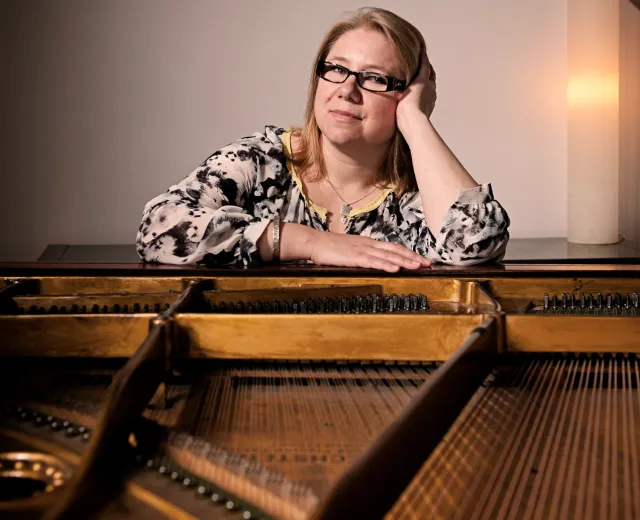
PianoMe is used not only by local musicians but also internationally. Renowned blogger and pianist Frances Wilson is among our users. In our interview, she shared insights from her many encounters with musicians through her popular Meet the Artist interview series, as well as her experiences as an advanced amateur pianist, and explained why she values the idea behind PianoMe.
PianoMe (PM): Dear Frances, thank you very much for your time! It is a great pleasure for us that you are ready for an interview with PianoMe!
Frances Wilson (FW): Thank you for inviting me!
PM: That’s great, thank you! First of all, we would like to briefly introduce you to our readers, although many of them will probably already be familiar with your work. You have established a strong presence in the UK classical music scene through your blog The Cross-Eyed Pianist, which you founded in 2010, as well as through your many connections with musicians via the popular Meet the Artist interview series. In addition, you are a regular contributor to a number of classical music websites, you write programme notes for several leading UK concert venues, and you are a co-founder and editor of ArtMuseLondon. You are also an advanced amateur pianist. Have I missed anything? (laughs)
FW: (laughs) Yes, that’s nearly all of what I do! In addition, I work as a publicist/PR with a small portfolio of clients (individual musicians and composers, music organisations/charities, and music festivals), and I’m Concerts Manager for Chamber Music Weymouth, a popular lunchtime concert series based in Weymouth, a seaside town in west Dorset, UK (where I live), working alongside concert pianist and educator Duncan Honeybourne.
Frances Wilson – Background and Motivation
PM: That sounds great! To start with, could you tell us how you began playing the piano and what led you to return to it seriously after nearly 25 years away?
FW: I think I was probably about 5 when I first started playing the piano, and I was probably influenced by my paternal grandfather who had an upright piano in the front room of his house. The piano stool was full of old manuscripts of popular songs (from the Edwardian era and early 20th century) and scores of Beethoven and Haydn in particular. My grandfather would play Methodist hymns and excerpts from pieces by Beethoven, and I remember sitting beside him as he played. I took formal piano lessons until I was 18, passing all my grade exams. Then I left home for university and largely stopped playing for 25 years. When my son started primary school, my mother bought me a digital piano and suggested I start playing again, and I was pleased to find that I hadn’t forgotten (!) and that I still had a reasonable amount of technical facility. Not long after, I started teaching piano to the children of friends, and a couple of adult students. One of the adult students was very nervous at the piano, despite being a confident, successful woman who ran her own business, and I decided that to better understand her anxiety, I would start taking lessons again myself. I was fortunate to find a very sympathetic and highly skilled teacher (Penelope Roskell), and within 18 months of starting regular private lessons with her, she suggested I study for a professional performance diploma, which I passed with distinction at 45. I subsequently took a further, higher diploma, also passing with distinction.
PM: Interesting! You have been writing extensively about classical music for many years. What originally inspired you to focus on this field, and what continues to motivate your work today?
FW: My blog started initially as a kind of practice diary. I’d been taking piano lessons for about 18 months and decided that rather than keep a traditional practice diary, I would put it online. I had some experience with blogging with a food blog called Demon Cook, so I knew how to set up and manage the site. Fairly quickly, I found that people were reading and responding to my articles, commenting that my experience was inspiring and supportive, and I began to forge connections within the UK amateur piano world. In addition to blogging about the music I was working on, I started reviewing concerts and recordings, which led to a job as a reviewer for Bachtrack.com and other writing opportunities.
The blog is a form of discipline for me, not unlike piano practice. I enjoy the activity of writing, and I find there is still plenty to write about – from articles on repertoire and technique to new releases or more esoteric “think pieces” and contributions from guest writers. I guess this is what motivates me to keep it going.
PM: Through your blog The Cross-Eyed Pianist, you have created a significant platform within the classical music world. What was your initial vision for the blog, and how has it evolved over time?
FW: As I said above, I initially started the blog as a practice diary to keep a record of the music I was studying with my teacher, my experience of returning to lessons as an adult, and the experience of taking formal music qualifications in my mid- and late-40s. But I quickly realized that to keep the site interesting and relevant, it should act like a kind of magazine, with varied and regularly updated content. This is one of the reasons why I launched the Meet the Artist interview series in 2012.
Over the years, the focus of the site has shifted away from primarily the piano to include broader content but still with a focus on classical music. The site is also useful for my PR work: I built my reputation through the site and people recognize it (and me) as an authority in the UK classical music scene.
PM: You started the London Piano Meetups several years ago, and they have become an important real-life networking space. What inspired you to create them?
FW: Through my piano teacher Penelope Roskell, I met another amateur pianist who played at a similar level to me, but who, like me, was finding it difficult to connect with other amateurs. So we decided to found the London Piano Meetup Group in 2013, and it quickly became a “club” for adult amateur pianists of all levels to get together and perform in a supportive environment. It’s still going strong, and remains very popular, and it has inspired other piano meetup groups, not just in London.
Observations from the Classical Music Scene – Frances Wilson
PM: In your view, how important are informal, in-person gatherings for musicians today, and what impact have these meetups had on participants and the wider piano community?
FW: Based on my own experience and conversations with others at the London Piano Meetup Group and on courses for amateur pianists, such groups offer amateur pianists important performance opportunities and a way to connect with others in a friendly, uncritical setting. For some members, the opportunity to perform in such a setting, on a really good-quality grand piano, in a supportive atmosphere, can be empowering and inspiring.
PM: You were involved in the meetups for many years and remain in contact with many musicians through your Meet the Artist series. What have you learned from these conversations?Are there recurring themes or concerns that musicians bring up when speaking about their careers?
FW: I think the biggest take away from the Meet the Artist series for me is that musicians are ordinary people who do something extraordinary, not dissimilar to elite sportspeople. And like elite sportspeople, training often begins at an early age and requires a great deal of commitment and passion. Also, that they define “success” not in financial terms but rather if they have touched the audience through their music or taken people outside the everyday through a performance, that is a mark of success. Since the pandemic, many musicians have talked about the competitiveness of the industry and the difficulty of securing engagements and decent fees. And more recently, concerns are being raised about the impact of AI on composers and the wider creative industries.
PM: Based on your extensive contact with musicians, what are the most significant changes you have observed in the classical music scene in recent years?
FW: More openness in musicians talking about injury and mental health issues. The taboo surrounding these things is beginning to fade, fortunately. More experimenting in programmes, venues, use of multi/mixed media. A loosening of the formality around classical music, and the perceived “high brow” or “elitist” nature of the art form.
PM: Do you see differences in the challenges and opportunities for new artists versus established musicians? What would you say are the biggest hurdles classical musicians in the UK face today?
FW: Financial and career sustainability are major considerations for nearly all classical musicians. Most cannot survive on concert fees alone, so teaching is often a main source of income. There is also the uncertainty that comes from being self-employed/freelance.
For musicians in the UK, Brexit has led to difficulties with touring, including more complex visa requirements etc.
Funding is a really major issue, with ever greater competition for funding, sponsorship and financial support.
For young/new artists, there are anxieties around securing auditions or performance opportunities; young/new composers getting their music heard; managing work-life balance, mental and physical health. And doing all of this, and more, in a highly competitive profession.
PM: Thanks for sharing your thoughts. Speaking of organizers, what do you think are the biggest challenges classical concert organizers are dealing with these days?
FW: Financial challenges are the greatest (see above). From my experience as Concerts Manager for Chamber Music Weymouth, there is no shortage of artists seeking performance opportunities, but organizers are often restricted by money, especially those which receive little or no state or other support.
PM: And then there’s the audience. How do you think audience behavior has changed, and what does that mean for programming and marketing?
FW: I think audiences have become more relaxed, as the “rules of etiquette” around classical music have loosened. This has encouraged promoters, concert organizers, venues and musicians to consider non-standard or more unusual programmes and concert formats. However, I see promoters and venues constantly trying to hook “younger audiences”, with marketing which risks alienating the core classical music audience (age 55+).
PM: Based on your experience in the scene, what would you say are the best ways for musicians to apply for concerts these days?Do you think an online platform could help make this process more transparent? And if so, how do you see digital platforms helping to connect musicians with concert organizers?
FW: Musicians need to present themselves in the best way possible, just as one would for an important job interview. This includes offering properly considered potential programmes, video clips to demonstrate one’s work, endorsements from others/critics. One doesn’t need an artist manager or agent to do this, but one does need to have good quality supporting material when applying for concerts. Digital platforms are important showcases for one’s work and are definitely a useful way of connecting musicians with organizers and promoters.
Personal Perspective
PM: As an advanced amateur pianist yourself, how does your own playing influence the way you write about music and musicians?
FW: My playing has led me to write from my own perspective – so if I’m describing a technical issue in a specific piece of music, I will explain what I have found challenging and how I have found a solution, rather than relying on a standard or generic explanation. This is something I learnt through my teaching too – there is no “right way”, and there’s no “one size fits all”.
In my reviewing, I suppose my own experience – albeit limited – as an advanced amateur pianist gives me an appreciation of the work that goes into preparing, finessing and performing a concert programme.
PM: What advice would you give to musicians who are trying to build sustainable and fulfilling careers today?
FW: If I can quote from many of the Meet the Artist interviews, “be yourself”, “don’t compare yourself to others”, work hard, present yourself well outwardly (e.g. good quality images, social media, website, recordings/videos etc), but also cut yourself some slack now and then to avoid burn out. Also – and I think this is particularly important post-pandemic – if music is not your full-time job (because you need another income stream), it doesn’t stop you from being a musician.
PM: Thank you! I’m really sorry, but I have to ask (laughing). What is your opinion on sharing rehearsal spaces by hosting a rehearsal space on an hourly basis?
FW: I think it’s a great idea, especially for those for whom funds are limited or who don’t need a whole day’s rehearsal.
PM: Finally, what are your aims for the future? Would you like to share any announcements with our readers?
FW: I would like my blog to reach its 20th birthday in 2030. Otherwise, I have no major announcements, other than I am continually grateful to everyone who reads, comments on and shares my blog, my interviews, and my other writing, and to the musicians whose music enriches our lives every single day.
PM: Dear Frances, we thank you for the interview and wish you all the best!
FW: Thank you! It has been a pleasure to answer your questions.
Copyright photo:
Photo at the head of the interview – James Eppy
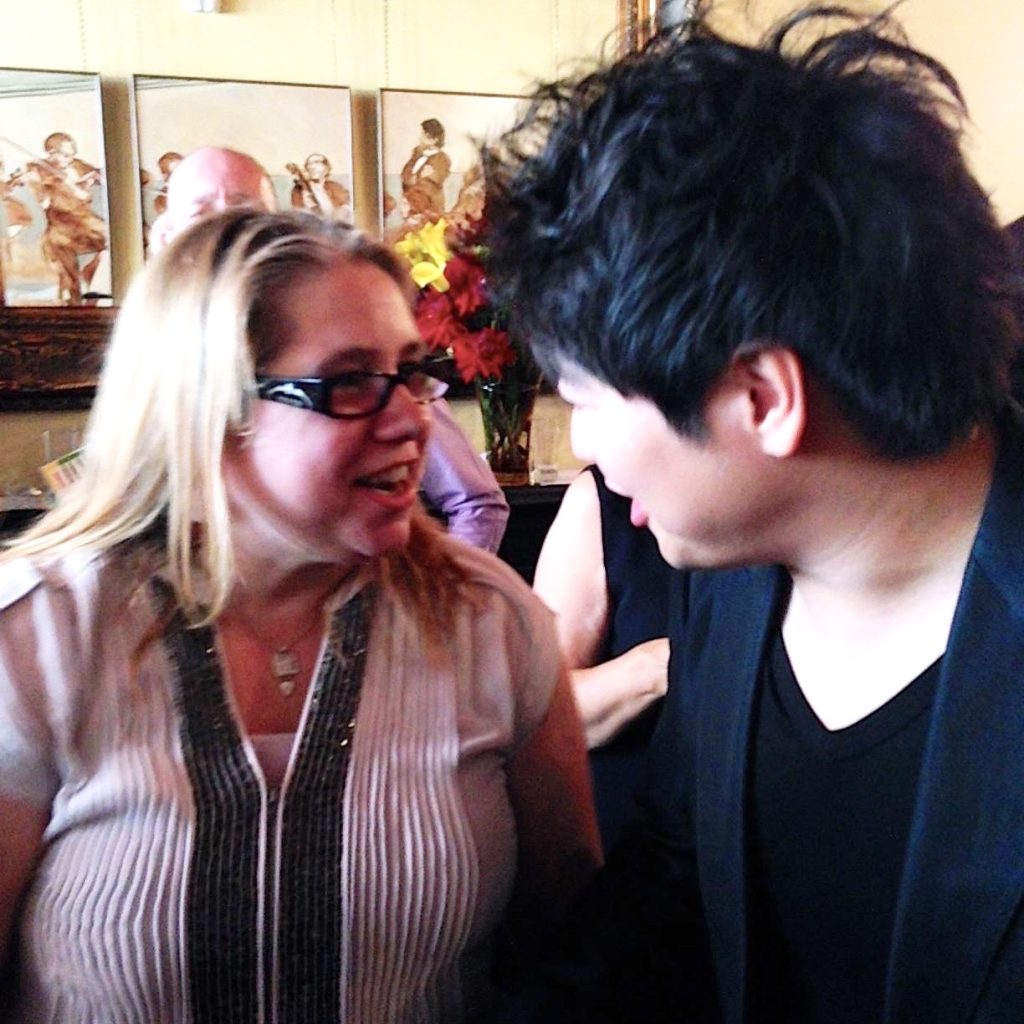
Photo of Frances Wilson with Lang Lang was taken by the editor of Pianist magazine / Frances Wilson